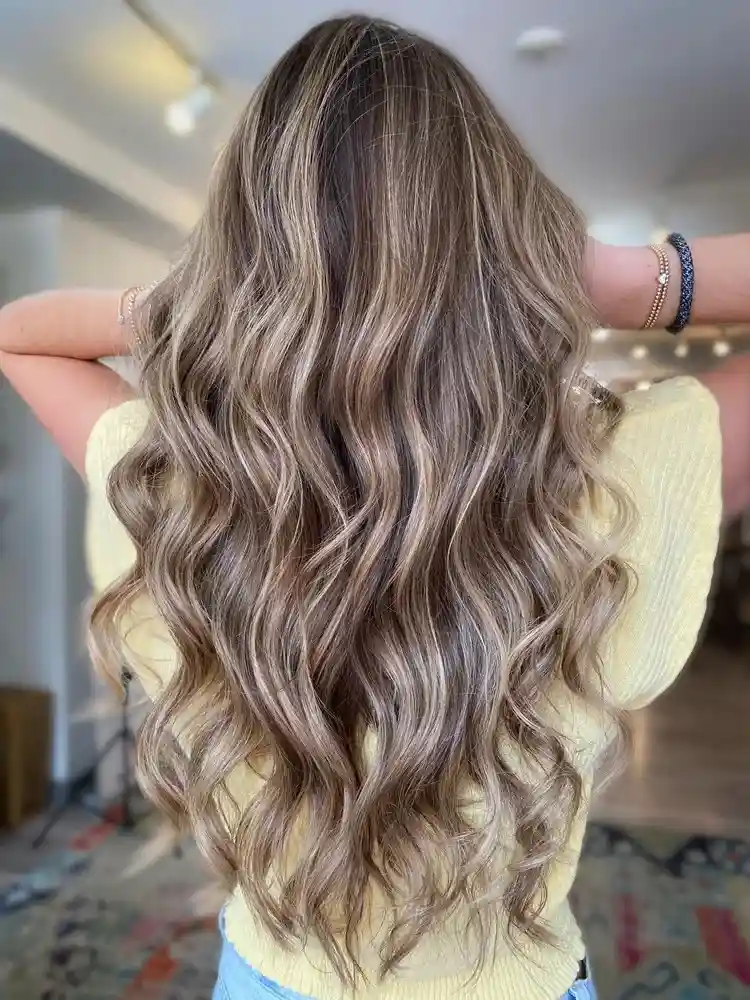
Quick answer: Foilyage is a hybrid highlighting technique where a stylist hand-paints color onto sections of hair, the same way they would for balayage, then wraps those painted sections in foil to trap heat and boost lift. The result combines the natural, soft placement of balayage with brighter, more lifted color than balayage alone typically achieves — making it especially useful on darker or more resistant hair.
Foilyage comes up constantly in color consultations, and for good reason: it sits in a genuinely useful middle ground between two very different techniques. This guide explains exactly what it is, how it compares to balayage and traditional foils, who it works best for, and what to expect if you book it.
What Is Foilyage, Step by Step?
The name itself is a portmanteau of “foil” and “balayage,” and it describes the process fairly literally. A stylist starts by hand-painting lightener onto sections of hair, following the hair’s natural fall the same way they would for a balayage service — this is what gives foilyage its soft, blended placement rather than the harder lines of traditional foiling patterns.
The difference comes right after the paint is applied: instead of leaving those painted sections open to air (as in standard balayage), the stylist wraps each one in foil. That foil traps heat against the hair, which speeds up processing and allows the lightener to lift further than it would if left uncovered. The trade-off balayage makes for a soft, forgiving grow-out — less lift per session — is exactly what foilyage is designed to solve.
Foilyage vs. Balayage
Balayage and foilyage start the same way (hand-painting) but diverge at the foil step, and that one difference changes the outcome more than people expect.
Left open to air, balayage develops more slowly and gently, which produces a very soft, diffused result with minimal visible demarcation between colored and natural hair. That’s exactly why balayage grows out so forgivingly — there’s no hard line to grow out in the first place. But that gentleness has a ceiling: on hair that’s naturally dark, resistant, or previously colored, balayage alone often can’t achieve a dramatically lighter result in one session.
Foilyage keeps the hand-painted placement but uses foil to push the lift further, which is why it’s often recommended specifically for clients with darker natural bases who still want that soft, lived-in look rather than the more structured brightness of full foils. If you want a deeper side-by-side on this specific comparison, we’ve written a full breakdown in our guide to balayage vs. foilyage.
Foilyage vs. Foil Highlights
It’s easy to assume foilyage and traditional foil highlights are basically the same thing because both involve foil, but the application method is completely different, and that changes the visual result.
Traditional foil highlights — whether full or partial — are sectioned and placed in a defined pattern using a comb and foil sheet, which creates clean, structured color with strong contrast. Foilyage starts with freehand painting, so the placement follows the hair’s natural movement rather than a geometric pattern, and the foil is used to intensify lift rather than to define sections.
The practical difference: foil highlights read as more polished and uniform; foilyage reads as more natural and dimensional, just brighter than balayage alone.
| Foilyage | Balayage | Foil Highlights | |
|---|---|---|---|
| Application | Hand-painted, then foiled | Hand-painted, open-air | Sectioned, foil-wrapped |
| Placement | Soft, freeform | Softest, freeform | Structured, defined |
| Brightness | Brighter than balayage | Softest overall | Brightest, most uniform |
| Best for | Darker bases wanting more lift | Low-maintenance, natural look | Maximum brightness/contrast |
| Grow-out | Fairly forgiving | Most forgiving | Most visible |
Who Is Foilyage Best For?
Foilyage tends to work especially well for clients with naturally darker hair who want real, visible brightness rather than a subtle shift — this is the group balayage alone often can’t fully satisfy in one appointment. It’s also a strong fit for anyone who loves the general look of balayage but has found it doesn’t lift their hair enough to reach the tone they actually want.
It also suits clients gradually transitioning from brunette toward blonde, since foilyage can be dialed in to add meaningful lightness without going all the way to a full, bright blonde in a single visit. And it works well for people who want their color to look dimensional and natural up close, not flat or uniformly one-tone.
Foilyage is less suited to clients chasing a bold, completely even, all-over blonde — for that specific goal, full foil highlights or double process color will generally get there faster and more reliably, since foilyage is built around blended, dimensional placement rather than uniform coverage.
What Happens During a Foilyage Appointment
A foilyage appointment at a professional salon generally follows this sequence:
Consultation. Your stylist looks at your natural base color, any previous color history, and talks through your target tone — this conversation shapes exactly how much lift the foilyage needs to achieve.
Hand-painting. Lightener is painted onto sections following your hair’s natural part and fall, concentrating more product toward the mid-lengths and ends where a sun-lightened look naturally occurs.
Foiling. Each painted section is wrapped in foil to trap heat and push the lift further than open-air balayage would achieve.
Toning. Once the lightener is rinsed out, a custom toner is mixed and applied to fine-tune the final shade and neutralize any unwanted warmth.
Finishing treatment. Most foilyage appointments close with a gloss or conditioning treatment to lock in shine and smooth the cuticle.
Depending on your hair’s length and how much lightening is needed, a foilyage appointment typically runs 2.5 to 4 hours.
Maintaining Foilyage Color
Foilyage lifts hair more than standard balayage, so a slightly more attentive aftercare routine helps the color hold up.
A sulfate-free, color-safe shampoo protects both the tone and the hair’s condition longer. Purple shampoo, used once or twice a week rather than daily, keeps brassiness from creeping back in without over-toning the hair. Weekly deep conditioning matters more here than with lower-lift services, since any additional lightening pulls more moisture and protein out of the hair shaft. Toning refreshes every 8 to 10 weeks keep the color balanced between full appointments.
Because foilyage is often chosen specifically for darker, more resistant hair, it’s also worth being mindful of heat styling in the weeks right after your appointment — freshly lightened hair is more porous and more vulnerable to heat damage until it’s had a chance to be conditioned and reinforced.
Foilyage and Hair Health
Because foilyage is often chosen specifically to push lift further than balayage alone can achieve, it’s worth understanding what that means for hair health. Any technique that increases lightening also increases porosity — the hair’s ability to absorb and lose moisture — which is why the finishing and aftercare steps matter as much as the coloring itself.
A skilled colorist accounts for this in a few ways: they’ll typically incorporate a bond-building product (applied either during the lightening process or as part of the finishing treatment) to help protect the hair’s internal structure while it’s being lifted. They’ll also be honest about pacing — if your hair needs more lift than can be safely achieved in a single visit without risking damage, a good stylist will recommend spacing the process across two or more appointments rather than pushing for a dramatic one-session result.
This is one of the clearest ways to tell the difference between a colorist who’s simply comfortable with the foilyage technique and one who genuinely specializes in blonding: the willingness to say “not today” when a client’s hair isn’t ready for the full amount of lift they’re asking for.
Foilyage for Different Hair Types
Foilyage adapts reasonably well across hair textures, but the placement and technique shift slightly depending on what you’re working with. On straight hair, the hand-painted sections tend to show clean, visible dimension since there’s less natural texture to blend the transitions. On wavy or curly hair, foilyage often looks even more natural, since the hair’s existing movement helps blend the painted sections into the rest of the color. Fine hair usually needs a slightly lighter hand with placement to avoid looking patchy, while thicker or coarser hair can generally handle broader, more saturated sections.
None of this changes the fundamental technique, but it’s part of why the consultation matters — a stylist experienced with foilyage across different hair types will adjust the painting pattern to suit your specific texture rather than applying the same approach to every client.
Foilyage: Frequently Asked Questions
Is foilyage more expensive than balayage? Generally, yes — foilyage typically costs somewhat more than balayage because it involves an additional step (foiling) and often more processing time to achieve extra lift. Exact pricing depends on your hair length, density, and how much lightening is needed.
Does foilyage work on short hair? Yes. Foilyage is defined by the technique, not hair length — it can be adapted to shorter cuts, though the placement pattern will look different than on longer hair.
Is foilyage better than balayage? Neither is objectively better — they solve different goals. Balayage is the lower-maintenance, softest option; foilyage adds brightness for clients whose hair or goals need more lift than balayage alone provides.
Can foilyage be done in one session, or does it need multiple appointments? Most foilyage services are completed in a single appointment. Very dark or previously colored hair may need more than one session to reach a lighter target shade safely without compromising hair health.
Final Thoughts
Foilyage exists precisely because balayage and traditional foils don’t cover every situation — it’s the technique built for clients who want the natural, blended placement of hand-painted color with more brightness than open-air balayage can deliver. If you’re not sure whether foilyage, balayage, or foil highlights fit your hair and goals best, that’s exactly the kind of question a consultation is meant to answer.
Book your consultation at Blonde & Bronde Salon on Newbury Street to find the right technique for your hair.