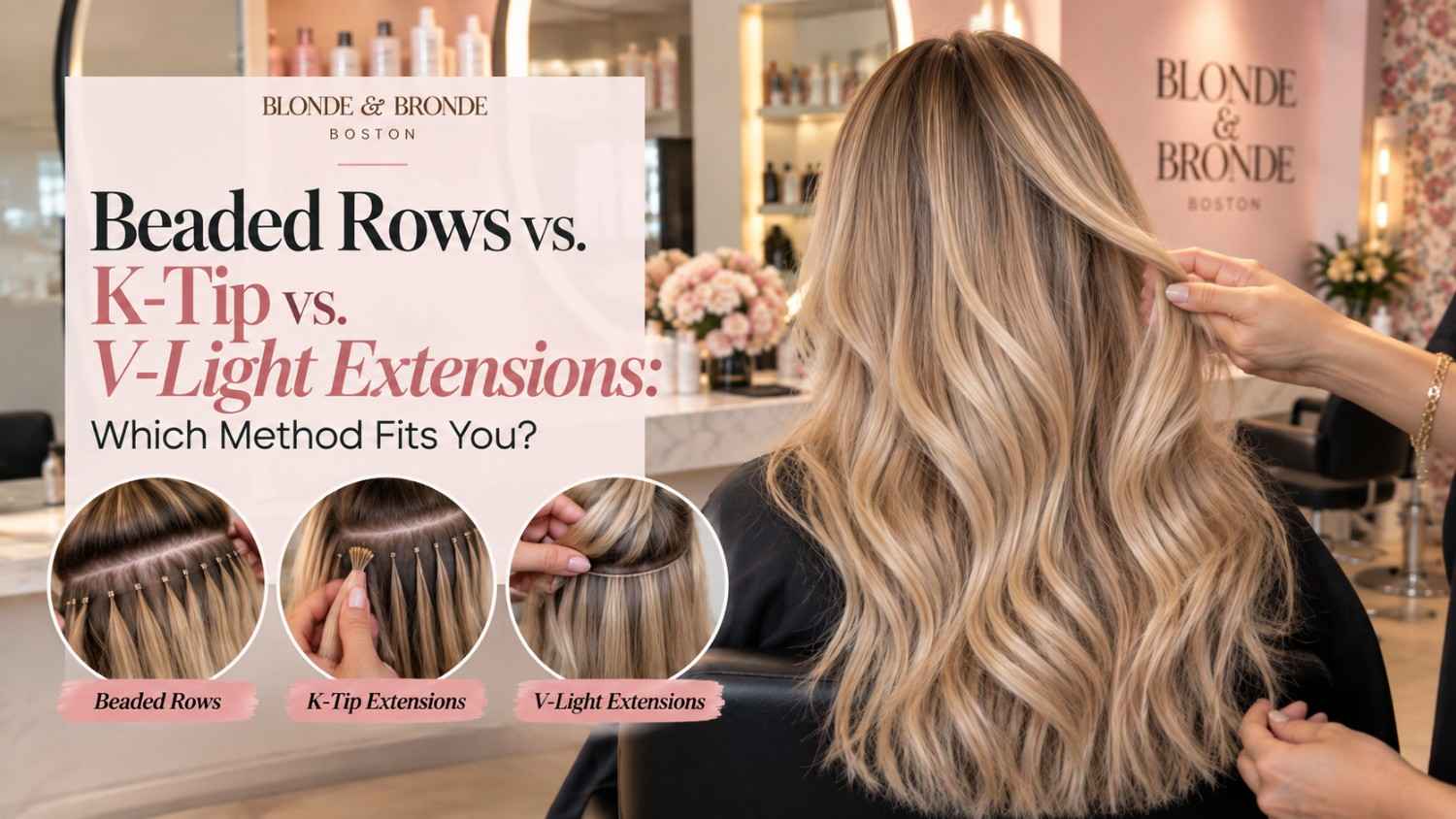
Quick answer: Beaded rows use silicone-lined beads with no heat, glue, or tape, making them the gentlest option and a strong pick for fine or fragile hair. K-tip extensions are fused on with keratin bonds and heat, giving a more seamless, individual-strand blend for those wanting the most natural movement. V-light sits between the two, using a lower-heat bonding method that’s less intensive than K-tip but more secure than beads. The right choice comes down to your hair’s condition, how much upkeep you want, and how natural you need the result to move.
If you’ve been researching extensions for more than five minutes, you’ve probably run into all three of these names without a clear explanation of what actually separates them. They’re not interchangeable, and the best one for you depends on more than just budget – hair type, lifestyle, and how much maintenance you’re willing to commit to all matter just as much.
What Are Beaded Row Extensions?
Beaded row extensions attach wefts of hair to your natural hair using small, silicone-lined beads – no glue, tape, or heat involved. They’re sometimes called Natural Beaded Rows (NBR), hand-tied wefts, or Invisible Bead Extensions (IBE). Because there’s no heat or adhesive, this is considered the lowest-tension, gentlest method of the three, which makes it a common recommendation for hair that’s already been through color processing or is on the finer, more fragile side.
What Are K-Tip Extensions?
K-tip extensions (sometimes called keratin-tip or fusion extensions) attach individual strands of hair using a keratin-based bond, fused to your natural hair with a heated tool. Because the extensions are applied strand by strand rather than in wefts, K-tips tend to blend more seamlessly and move more naturally, especially with finer partings or updos where a weft’s row might be more visible. The tradeoff is that the heat and bonding process is more intensive than beaded rows, and removal requires a bond-softening solvent rather than simply unclipping or cutting out beads.
What Is V-Light?
V-light extensions use a bonding method that sits between beaded rows and K-tip in terms of intensity – a lower-heat, more flexible bond that’s less taxing on natural hair than traditional keratin fusion, while still offering more security and a closer, more seamless attachment than beads alone. It’s often positioned as a middle-ground option for clients who want K-tip’s natural movement without the higher heat exposure of traditional fusion.
How Do These Three Methods Actually Compare?
- Heat and damage risk: Beaded rows use no heat at all, V-light uses a lower-heat process, and K-tip uses the most direct heat exposure of the three.
- How natural the movement looks: K-tip and V-light, applied strand by strand, generally allow more natural movement and finer parting flexibility than wefted beaded rows.
- Maintenance appointments: Beaded rows typically need a move-up appointment every 8 to 10 weeks as natural hair grows out from the beads. K-tip and V-light also need periodic move-ups, generally on a similar timeline, though exact spacing depends on your natural hair growth.
- Removal: Beaded rows can be removed without any solvent or heat. K-tip and V-light require a bond-release product to safely remove without damaging natural hair.
- Best for: Beaded rows suit fine, color-treated, or damage-prone hair that needs the gentlest option. K-tip suits clients wanting maximum natural movement and can tolerate the more intensive application. V-light suits clients who want that same seamless movement but with a gentler process than full keratin fusion.
Which Method Lasts the Longest?
With proper care, beaded row extensions can last up to a year on the same set of hair, with regular move-ups to keep them secure and blended as your natural hair grows. K-tip and V-light extensions also last a long time on the hair itself, but how long any given installation looks its best before a move-up is needed depends more on your natural hair growth rate than on which method you chose.
Does Hair Texture Affect Which Method Works Best?
Yes. Fine, thin, or textured hair often does better with beaded rows or V-light, since both apply less direct stress to individual strands than traditional keratin fusion. Thicker, more resilient hair has more flexibility to handle any of the three methods safely, which usually means the decision comes down to lifestyle and desired look rather than what your hair can tolerate.
What Should You Bring Up During Your Consultation?
- Your hair’s current condition, including any recent color services, since that affects which method is safest right now
- How much time you’re realistically willing to spend on move-up appointments
- Whether you wear your hair in styles (like a sleek low ponytail or fine, precise partings) that would make a wefted method more visible than a strand-by-strand one
- Your budget, since hair sourcing, color-matching, and installation time all vary by method and by how much hair is needed
Since extension hair has to be ordered and color-matched in advance for beaded rows specifically, this is exactly the kind of decision worth working through during a personalized hair consultation rather than choosing a method sight unseen.
Can You Switch Methods Later?
Yes, and many clients do, especially after trying one method and finding they’d prefer the maintenance schedule or feel of another. Switching isn’t a problem as long as your natural hair has had time to recover between installations, particularly if you’re moving from a heat-based method like K-tip to something gentler like beaded rows.
Frequently Asked Questions
Which extension method is best for damaged or color-treated hair?
Beaded rows are generally the gentlest option, since no heat, glue, or tape is used during application.
Do K-tip extensions damage natural hair?
When applied and removed properly by a trained stylist, K-tip extensions are considered safe, though the heat-based bonding process is more intensive than beaded rows or V-light.
How often do beaded row extensions need to be moved up?
Typically every 8 to 10 weeks, to keep them secure and blended as natural hair grows out from the original bead placement.
Is V-light better than K-tip?
Neither is universally better – V-light offers a gentler bonding process than traditional K-tip while still providing similar natural movement, making it a middle-ground choice for some clients rather than a strict upgrade.
Final Thoughts
There’s no single “best” extension method – there’s a best method for your hair, your lifestyle, and how much maintenance you actually want to commit to. Beaded rows, K-tip, and V-light each solve a slightly different problem, and the right choice usually becomes obvious once your hair’s current condition and your daily routine are actually factored in.
Not sure which method fits your hair? Book a consultation and get a hands-on recommendation instead of guessing from a list.