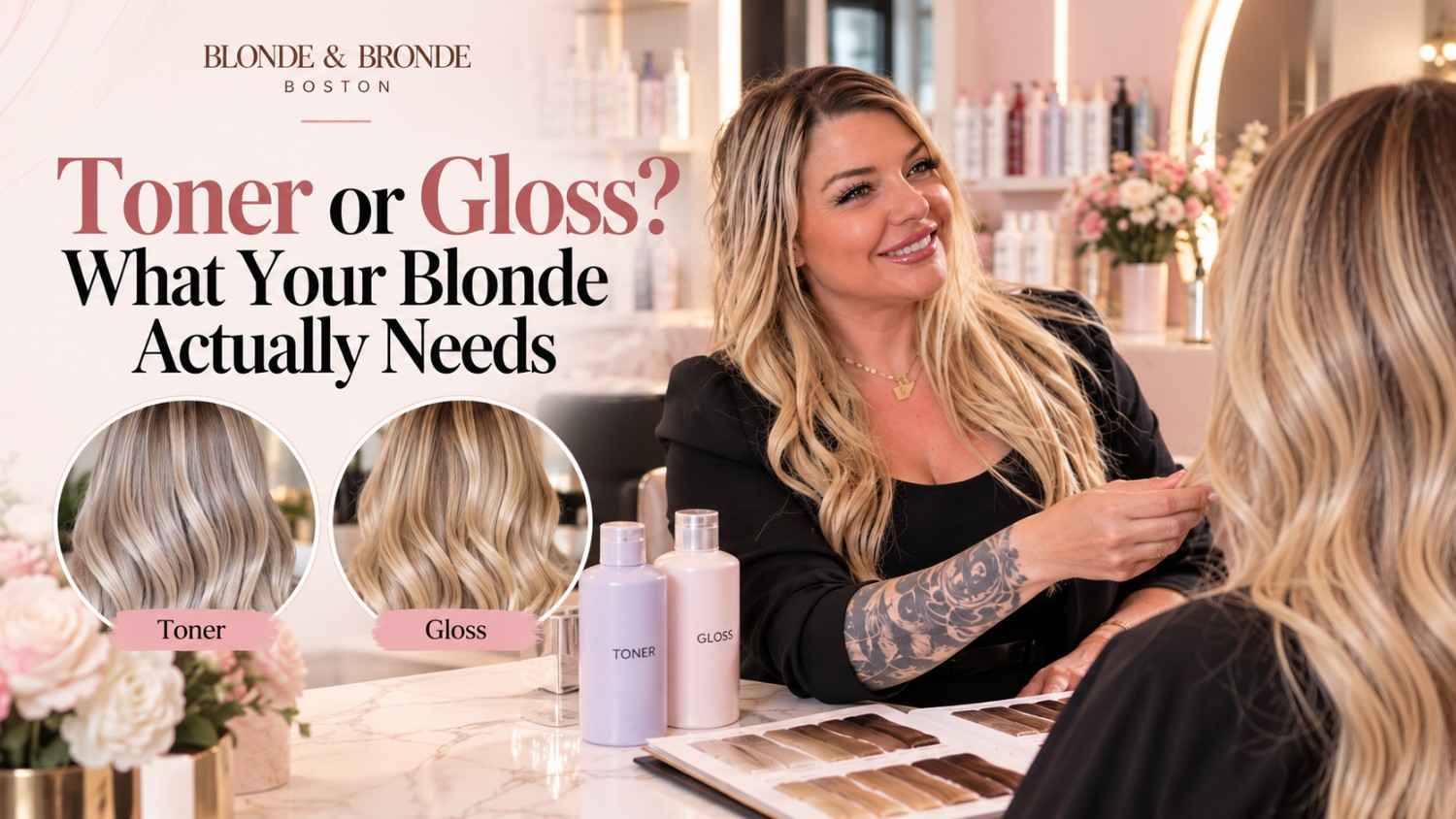
Quick answer: Toner corrects color. It neutralizes the yellow or orange that shows up after hair is lightened and sets your final shade. Gloss adds shine and a sheer wash of tone, and it smooths the surface of the hair. Neither one lightens hair, both fade gradually, and in a salon the two often overlap in a single formula. If your blonde looks brassy, you probably need toner. If it looks flat or dull, you probably need a gloss. Most blondes refresh one or the other every four to eight weeks.
Ask five stylists to define toner and gloss and you’ll get five slightly different answers, which is exactly why clients get confused. Both words show up on service menus, in the add-on list, and in the aftercare notes from your last appointment, usually with no explanation attached. Here’s what each one does, where they overlap, and how to tell which one your hair is asking for.
Why Does Blonde Hair Need Toning at All?
Hair has natural pigment, and lightener works by breaking that pigment down. As it lifts, hair moves through stages of warmth, from red-orange toward orange-yellow and finally pale yellow. That’s why freshly lightened hair often looks more golden or brassy than the blonde in your reference photo. Lightening gets you to the right level of brightness, but it doesn’t deliver the right tone. Toning is the second step that does.
Skip it, and even a well-executed balayage can read yellow, orange, or flat. This is also why you’ll see a toner or gloss built into nearly every lightening service rather than treated as an optional extra.
What Is a Toner?
A toner is a color formula applied after lightening to neutralize unwanted warmth and set the final shade. It works on the color wheel: violet pigment cancels yellow, and blue pigment cancels orange. Toners are typically demi-permanent or semi-permanent, which means they deposit color onto the hair without lifting it and without the commitment of permanent dye.
Applied to freshly shampooed hair, a toner processes for a short time, and the result is the shade you actually asked for: ash, beige, champagne, soft gold. Because it deposits pigment on the hair rather than building it in permanently, it fades gradually with washing, heat, and sun.
What Is a Gloss?
A gloss is a translucent, usually ammonia-free color treatment that adds shine, smooths the hair’s surface, and shifts tone slightly. Think of it as a sheer wash rather than a full coat of color. It won’t lift your hair or dramatically change your shade. Its job is to make the color you already have look richer, more even, and more reflective.
That’s why a gloss works on blonde, brunette, and everything in between. On a natural brunette, it brings back depth and shine with no lightening at all. On blonde, it refines the tone and gives the hair that finished, light-catching look. The smoothing effect is temporary, and a gloss isn’t a repair treatment, but it changes how hair looks and feels fast, often in a single short appointment.
Are Toner and Gloss Actually the Same Thing?
Not exactly, but they overlap more than most service menus admit. Both are lower-commitment than lightening, both deposit pigment, and both fade over time. The practical difference is intent: a toner is chosen to correct or set tone, while a gloss is chosen for shine and subtle refinement. In the chair, a lot of formulas do both jobs at once, and salons use the words loosely, sometimes interchangeably.
So instead of getting stuck on the label, ask your stylist what the formula is meant to do for your hair. A good answer sounds like “cancel the yellow and keep it cool” or “add shine and warm it up slightly,” not just a product name. For what it’s worth, highlighting services at Blonde and Bronde, including full balayage and partial foil, include a customized all-over gloss or toner, so it isn’t something you have to book separately on color day.
How Do Toner and Gloss Compare Side by Side?
- Main job: Toner neutralizes unwanted warmth and sets the shade. Gloss adds shine, smoothness, and a sheer tone adjustment.
- Does it lighten hair? Neither one does.
- Best for: Toner suits freshly lightened or brassy blonde and shifts between cool and warm. Gloss suits dull or flat color on any base, blonde or brunette.
- Appointment length: Often under an hour as a standalone refresh.
- How long it lasts: Both fade gradually over several weeks, depending on your routine.
- Impact on hair: Gentler than lightening, but still a chemical service, so your hair’s starting condition matters.
Which One Do You Actually Need?
Match the symptom to the service:
- Your blonde looks yellow or orange, especially in daylight: toner.
- The tone is fine but the color looks flat, dull, or dry: gloss.
- You just had highlights lightened and want the shade dialed in: both, usually built into the service.
- You’re a brunette who wants richer shine: gloss.
- You want to move cooler or warmer without lightening further: a toner adjustment.
If none of those fit, because the color looks patchy, uneven, or has turned an odd shade, that points to something bigger than a refresh, and a hands-on look from your stylist beats guessing.
How Often Should You Refresh Your Toner or Gloss?
Most blondes land somewhere between four and eight weeks. Cooler, brighter blondes like ash and platinum sit at the shorter end, since there’s less warmth in the formula and any yellow that creeps back shows up quickly. Softer, lived-in blondes with a blended root can often stretch longer, sometimes pairing a refresh with a full color visit every few months.
Your own habits move that number too. Sun, hot water, heat styling, and frequent washing all speed up fading, so two people with the same shade can need different schedules.
Why Does Blonde Turn Brassy Again So Fast?
Because toner isn’t permanent, and a handful of everyday things wear it down:
- Hot water and frequent washing rinse pigment out faster. Cooler water and fewer wash days help.
- Sulfate-heavy shampoos strip color more aggressively than color-safe formulas.
- Sun and chlorine fade tone and can push blonde warmer, which matters after a summer of beach days or pool time.
- Heat tools dull tone over time, especially at high temperatures.
- Mineral and product buildup can leave blonde looking flat or off-tone. Depending on your water, a shower filter and an occasional clarifying wash can help.
Does Purple Shampoo Replace a Salon Toner?
No. Purple shampoo deposits a small amount of violet pigment with each wash, which helps hold off yellow between appointments. That makes it maintenance, not a substitute. Use it once or twice a week rather than every wash, because overuse can leave blonde looking dull or faintly lilac, especially on porous, previously lightened hair.
It also only targets yellow. If your hair is leaning orange, the pigment that cancels it is blue, which is why purple shampoo can only do so much, and why stubborn orange tones usually call for a salon toner instead of another bottle.
Can You Tone Your Hair at Home?
You can, and box toners exist, but lightened hair is porous and tends to grab pigment unevenly. At-home toning often goes patchy, too ashy, or muddy. If a toner already went sideways, or you’re looking at gray-green, lavender, or splotchy blonde, that’s no longer a toning question. It’s a job for a professional, and it often falls under color correction.
When Is Toner Not the Fix?
Sometimes brassiness isn’t really a tone problem. If your blonde turns yellow within days of toning, the cause is often that hair has been lightened and relightened until there’s very little depth left to hold the toner, or that the hair is too stressed to hold pigment evenly. Another gloss won’t fix that. Putting depth back in with reverse balayage often does.
And if your hair feels gummy, snaps easily, or won’t hold tone at all, the priority is strengthening it before adding any more color.
What Should You Ask Your Stylist About Toner and Gloss?
- What is this formula meant to do: cool the tone, warm it, add shine, or all three?
- How long should it last on my hair, given how often I wash and style?
- When should I come back for a refresh?
- Which shampoo should I use at home, and should I use purple shampoo at all?
- Is a gloss or toner already included in my service?
If you’re not sure whether your color needs a quick refresh or something bigger, that’s exactly what a personalized hair consultation is for. Your stylist can look at your hair in person and tell you which one it’s actually asking for.
Frequently Asked Questions
Does toner damage hair?
Toner is generally gentler than lightener because it deposits color without lifting, but it is still a chemical service. How your hair responds depends on its condition going in.
Is a gloss the same as a toner?
They overlap, but the intent differs. A toner is chosen to correct or set tone, while a gloss is chosen for shine and a subtle tone adjustment. Many salon formulas do both at once.
How long does a gloss last?
Most last about four to eight weeks, fading gradually. Hot water, sun, heat styling, and frequent washing shorten that.
Can toner make my hair darker?
It can make blonde look a touch deeper, since neutralizing yellow reduces brightness, but toner doesn’t lift hair and isn’t a permanent darkening.
Final Thoughts
Toner and gloss are the quiet half of every blonde service. Lightening gets the headline, but tone and shine are what make color look finished, and they’re also the first things to fade. Once you know which one solves which problem, a four-to-eight-week refresh stops feeling like a mystery add-on and starts feeling like the simplest way to keep your color looking like the day you left the salon.
Not sure what your color needs next? Book a consultation and get a straight answer for your hair.